
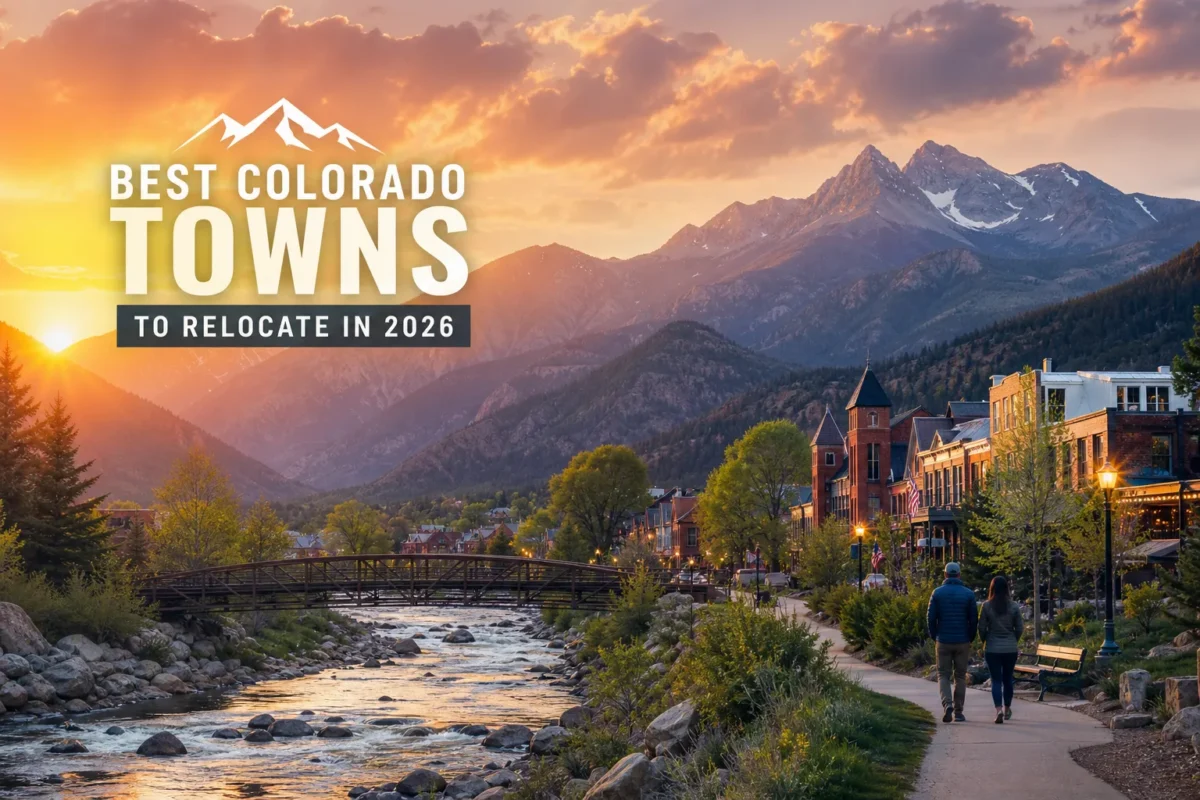
If you’re wondering what are the best Colorado towns to relocate to in 2026, you’re not alone, and the hardest part is no longer deciding whether to move. It’s deciding where. At Luxury Mountain Living, we’ve watched buyers pour into Front Range and Northern Colorado communities from across the country for years, and one thing becomes clear every time: the right town depends entirely on what you’re optimizing for. A retiree’s dream community is a remote worker’s wrong fit. A family chasing top schools may find the outdoor-first buyer’s perfect base town wildly overpriced.
This guide organizes the best Colorado towns to relocate to by what actually matters: housing costs, job access, school quality, commute reality, and outdoor lifestyle. By the end, you’ll have a short list of three to five towns worth visiting in person.
What are the best Colorado towns to relocate to in 2026?
Based on housing costs, school quality, job access, and lifestyle fit, the best Colorado towns to move to right now include Fort Collins, Loveland, Windsor, Timnath, Parker, Castle Rock, Colorado Springs, Boulder, Denver, and Longmont. Each one serves a different type of buyer, read on for a full breakdown of what makes each town worth considering, and which trade-offs come with it.
- Fort Collins, best overall for families and outdoor culture
- Loveland, best value on the Northern Front Range
- Windsor & Timnath, fastest-growing suburban gems
- Parker & Castle Rock, established schools and community infrastructure
- Colorado Springs, urban amenities at near-national-average cost
- Boulder, outdoor-first living with a premium price tag
- Denver, career depth and lifestyle range in one metro
- Longmont, the remote worker sweet spot
What separates a great Colorado relocation town from the rest
Not every Colorado town belongs on a relocation shortlist. The ones that do share a common set of strengths across five factors: median home price relative to income, cost of living, school district quality, job market health, and access to outdoor recreation. No single town wins on all five, and that’s completely normal. Trade-offs are baked into every decision here. The goal is to identify which trade-offs you’re actually willing to make before you fall in love with a town on paper that doesn’t fit your life.
In 2026, Colorado’s statewide job market is projecting modest growth of about 0.6%, according to the Colorado Department of Labor and Employment, led by education, health services, and trade. Northern Colorado’s growth corridor is seeing active new construction, and in-migration from high-cost states continues to reshape demand across the Front Range. Some communities, like Parker and Castle Rock in Douglas County, are fully established and competitive. Others, like Severance, Timnath, and Berthoud, are quietly emerging as the smart early moves before prices catch up to demand. Knowing which category a town falls into changes how you think about its value.
Best Colorado towns for families: schools, space, and community
Fort Collins: the benchmark for family living on the Front Range
Fort Collins consistently earns its spot at the top of family relocation lists, and the reasons hold up to scrutiny. Colorado State University anchors the local economy and drives a culture that feels genuinely engaged rather than just suburban. The Poudre School District ranks in Colorado’s top 11 out of 116 districts statewide and has earned a five-star rating from SchoolDigger, with math and English scores that beat state averages by double digits. Walkable neighborhoods and a thriving craft brewery scene round out the daily quality of life. Rocky Mountain National Park is roughly an hour’s drive from the city center, depending on your trailhead and traffic, close enough for frequent weekend trips without the price premium of living in a mountain town.
Median home prices in Fort Collins cluster around $530,000 to $560,000 in 2026, according to REcolorado MLS data, which is meaningfully below Denver’s $590,000 median and substantially below Boulder. The cost of living index sits at approximately 112, about three points below Denver and 12 points above the national average. For families relocating from high-cost metros, that math feels like a significant win. Fort Collins is not cheap, but it earns its premium in ways that are visible every day.
Windsor and Timnath: Northern Colorado’s fast-growing suburban picks
Windsor and Timnath are drawing strong interest from relocating families in 2026, with active new construction communities offering modern floor plans at entry price points that still undercut Fort Collins. Windsor’s RE-4 School District has earned solid marks from parents and local real estate professionals alike, and newer school campuses are a practical draw for families who want updated facilities alongside strong academics. Windsor Lake adds a genuine outdoor asset right inside the community, which matters to buyers who want recreation without the long drive.
Timnath sits just minutes from Fort Collins and offers proximity to that city’s amenities without the price premium. Buyers who want access to Fort Collins culture and employment without paying Fort Collins prices consistently land in Timnath. Both towns have a quieter suburban character that families from dense metros often find immediately appealing. The commute to downtown Denver runs about 58 to 60 miles, which translates to roughly an hour in normal traffic and longer during peak hours. That distance rules these towns out for daily Denver commuters but suits location-independent professionals well.
Parker and Castle Rock: established Front Range options with top schools
Douglas County communities have long attracted families who want Denver access combined with highly rated schools and established neighborhood infrastructure. Parker’s median home price sits around $680,000 based on 2026 Redfin data, and Castle Rock comes in near $695,000 based on local market estimates. Those figures are higher than anything in Northern Colorado’s emerging towns, but Douglas County schools are widely regarded as among the highest-performing in the state, a reputation backed by consistently strong CDE SchoolView metrics and rankings from Niche and SchoolDigger. The community investment in parks, trails, and recreation facilities is visible throughout both towns. For families who prioritize school district stability and neighborhood maturity above affordability, Parker and Castle Rock deliver.
Best Colorado towns for affordability and career opportunities
Loveland: the underrated alternative to Fort Collins
Loveland is the town buyers discover right after deciding Fort Collins is too expensive, and most of them are glad they made the discovery. The Thompson School District serves the community well, housing costs run noticeably lower than Fort Collins, and the cost of living index for Loveland lands in the 105 to 108 range, roughly seven to ten points below Denver. The Big Thompson Canyon corridor gives residents immediate access to hiking and outdoor recreation that would take a Denver resident 40 minutes of driving to reach. Loveland also has a genuine arts scene, with a bronze casting industry and gallery district that gives the town a creative identity most suburban communities lack.
We consider Loveland the most underrated market on the Front Range for first-time buyers and families who want Northern Colorado quality of life at a lower entry point. The I-25 corridor connects residents to both Fort Collins and Denver, making it practical for hybrid workers who need flexibility without sacrificing location. Entry-level inventory and price-to-income ratios here remain more favorable than in any comparable Northern Colorado city.
Johnstown, Severance, and Berthoud: Northern Colorado’s growth corridor
These three communities form what we’re watching closely in 2026 as Northern Colorado’s emerging market towns. New construction is active, home prices still undercut established neighbors, and infrastructure is catching up fast. Severance and Berthoud in particular have seen price appreciation over the past several years as demand moves north and east from Fort Collins, early buyers in these markets have generally benefited from that momentum. The trade-off is honest: fewer established amenities, less mature retail and dining ecosystems, and commutes to Denver ranging from 65 to 70 miles for Berthoud. But strong community investment is underway in all three towns, and buyers who recognize an early market tend to benefit most.
Colorado Springs: big-city benefits at a fraction of Denver’s cost
Colorado Springs belongs in this conversation for relocators who want urban amenities without Denver prices. The cost of living index sits around 102, barely above the national average, making it one of the most accessible major cities in Colorado. The Springs has a strong military economy anchored by Fort Carson and Peterson Space Force Base, a growing healthcare sector, and a diverse arts and dining scene that surprises people who expect a purely military-suburban environment. Job growth in the Colorado Springs metro hit 1.6% in 2024, the second-highest rate in the state, and the market has shown consistent resilience through 2025 and into 2026.
The honest trade-off here is distance. Colorado Springs sits about 70 miles south of Denver, which rules it out for anyone needing frequent Front Range access. For fully remote workers or those employed locally, that distance becomes irrelevant, and the cost savings are hard to argue with. For local industry context, defense, healthcare, and tech are the sectors hiring most actively, which is worth knowing for anyone evaluating local employment options.
Best Colorado towns for outdoor enthusiasts and remote workers
Boulder: outdoor access with a premium price tag
Boulder is the honest answer for outdoor-first buyers whose budget can support it. The Flatirons offer world-class climbing and hiking from the edge of the city. An established cycling culture with dedicated infrastructure, Pearl Street dining, and the University of Colorado make it one of the most dynamic small cities in the country. Job posting data from March 2026 (via LinkedIn and Colorado Department of Labor sources) shows Boulder as one of only two metro areas in Colorado with year-over-year gains, which reflects the resilience of its tech and innovation economy. The median home price, however, is the highest of any community in this guide, and Boulder’s cost of living is substantially above Fort Collins or Loveland. Boulder is the right choice when the budget and lifestyle align completely, not as a compromise pick.
Denver: the urban anchor for professionals who want it all nearby
Denver still makes the list of best Colorado towns to move to in 2026 for professionals who want career optionality above all else. The metro’s job market depth, DIA access, light rail infrastructure, and proximity to ski resorts, hiking, and mountain communities make it the logical default for people who don’t want to choose between career and lifestyle. The median home price sits around $590,000, and a cost of living index of 115 reflects a genuinely urban premium. Traffic and density are real trade-offs for buyers accustomed to smaller metros, and the housing market remains competitive. Denver’s range of employers across technology, healthcare, government, and professional services is unmatched anywhere else in Colorado.
Fort Collins and Longmont: where remote workers find their footing
For location-independent professionals, Fort Collins and Longmont consistently outperform their higher-profile neighbors on the value calculation. Reliable broadband infrastructure, a lower cost of living than Denver or Boulder, genuine outdoor culture without mountain-town isolation, and active creative and tech communities make both towns practical places to build a remote working life. Longmont in particular has absorbed a wave of remote workers priced out of Boulder who want proximity to that city’s amenities without the home price. The commute to Boulder runs under 30 minutes. Longmont’s brewing and maker community gives it a distinct identity that appeals to professionals who care about where they spend time off-screen.
How to choose your Colorado town: a practical framework
Two questions will narrow your list faster than any ranking. What is your realistic housing budget, including property taxes and any HOA costs? And are you optimizing primarily for school quality, outdoor access, affordability, or some combination of those? Most readers already know their answers. The exercise is about organizing those answers against a specific set of towns rather than browsing listings and hoping something clicks. A third consideration, whether you need proximity to a major employer or DIA, or are fully location-independent, usually clarifies which geographic tier makes sense.
Once you’ve narrowed to two or three communities, the highest-value move is connecting with someone who knows the specific neighborhoods, new construction timelines, school boundary details, and market shifts within each town. At Luxury Mountain Living, our team has guided relocators from across the country through exactly this process: not just finding a home, but finding the right town first, then the right street. With hyperlocal knowledge of the Northern Colorado and Front Range markets, backed by the global reach of the Coldwell Banker Global Luxury network, that kind of guidance is the difference between a guess and a confident decision. Reach out to us here to start the conversation.
The right Colorado community is closer than you think
Colorado is a genuinely exceptional place to build a life in 2026, and the decision is less about finding the “best” town on paper and more about matching a specific community to how you actually live. Fort Collins delivers for families who want school quality and community depth. Loveland rewards the value-conscious buyer who refuses to settle for less outdoor access. Boulder suits the outdoor-first buyer with budget to match. Windsor and Timnath are where smart relocators are landing right now, before prices catch up to the demand that’s already there.
Whatever shortlist you’ve built from this guide, the smartest next step is to visit each town, walk the neighborhoods during the week, and talk to someone who knows the market from the inside. If you’re still asking yourself what are the best Colorado towns to relocate to, the answer is already in this guide, the next move is yours.
Frequently asked questions about moving to Colorado towns
What are the best Colorado small towns to live in for families?
Fort Collins, Windsor, and Parker consistently rank among the best places to live in Colorado for families, based on school district performance, community infrastructure, and access to outdoor recreation. Timnath and Castle Rock are strong runners-up for families who want newer construction and established neighborhood amenities.
What are the most affordable Colorado towns to relocate to?
Loveland, Johnstown, and Colorado Springs offer the lowest cost of living among the towns covered in this guide. Severance and Berthoud also carry lower entry prices than established cities, though amenity infrastructure is still developing in both.
Which Colorado towns are best for remote workers moving to Colorado?
Longmont and Fort Collins are the top choices for remote workers, offering reliable broadband, strong community character, and lower costs than Denver or Boulder. Colorado Springs is a solid option for fully remote professionals who want urban amenities at a near-national-average cost of living.
Is moving to Colorado towns on the Front Range still a good investment in 2026?
Yes, particularly in Northern Colorado’s growth corridor. Windsor, Timnath, Severance, and Berthoud are seeing active development and price appreciation as demand expands north and east from Fort Collins. Established markets like Parker and Castle Rock remain strong for buyers who prioritize school quality and neighborhood maturity over entry-level pricing.